
Think Like an
Underwriter.
The course that teaches you how Canadian lenders actually make mortgage decisions. Master the file, anticipate every question, and close stronger deals — starting with your very next application.
Developed by top Canadian mortgage professionals. Content is reviewed and updated to reflect current lender guidelines, OSFI regulations and provincial requirements. Used by mortgage agents, underwriters and brokers across Canada.
Three ways this course changes how you work.
Read any mortgage file
Income, credit, property, conditions — you'll know exactly what you're looking at, what it means to a lender, and what needs to be addressed before submission. No more guessing. No more surprises.
Assess risk like a lender
Master the calculations, the red flags and the qualifying logic that shapes every mortgage decision. GDS, TDS, LTV, beacon scores, employment income, self-employed income — you'll know why each number matters and how lenders use it.
Submit with confidence
Prepare stronger applications because you understand what underwriters need before they ask for it. Identify file weaknesses before submission, structure around them, and build a reputation as a professional who knows the work.
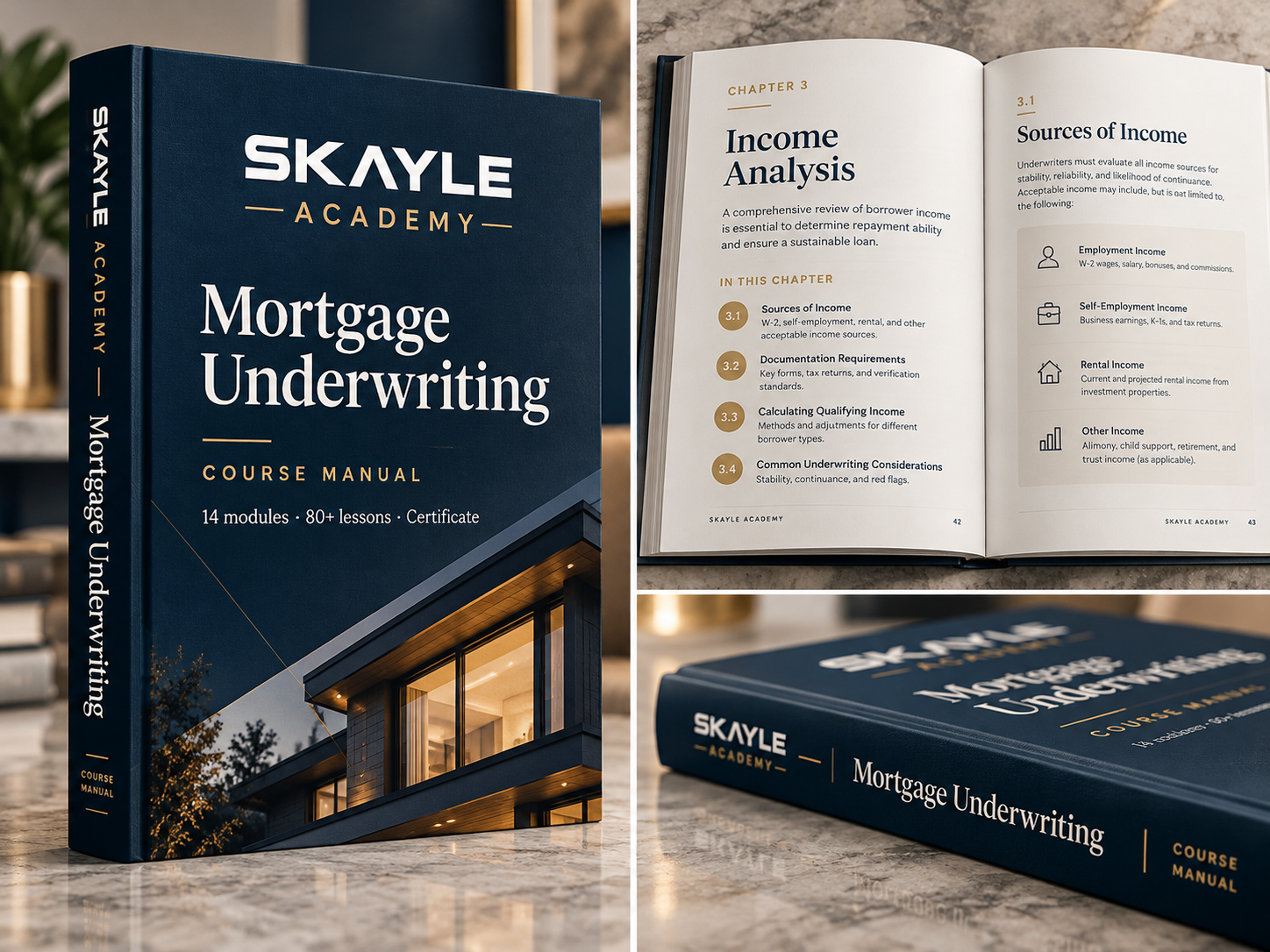
14 modules. Everything you need to master the file.
Every module is built around real Canadian mortgage scenarios — not textbook theory. You'll finish each module with knowledge you can apply immediately.
- The role of the underwriter in the mortgage process
- The three pillars: income, credit, property
- How lenders categorize borrowers and risk
- A-lenders, B-lenders and private lenders: the key differences
- How mortgage policy is applied to individual files
- The underwriting mindset: what are lenders protecting against?
- Reading a complete mortgage application (Form 3340)
- What information is required vs. optional
- Common errors and omissions agents make
- What triggers questions at the lender
- How to review your own file before submitting
- Reading an Equifax and TransUnion credit report
- How credit scores are calculated and what affects them
- Derogatory items: what they are and how lenders view them
- Consumer proposals, bankruptcies and discharges
- Co-borrower and guarantor credit considerations
- How to identify and address credit file issues
- Presenting credit to a lender effectively
- What qualifies as verifiable employment income
- Salaried vs. hourly vs. variable income: how lenders approach each
- Part-time, casual and contract employment
- Verification documents: T4s, pay stubs, employment letters
- Pension, disability and CPP income
- The two-year income rule and exceptions
- Traditional vs. stated income: which applies when
- Sole proprietors, incorporated borrowers and partners
- How lenders use T1 Generals and NOAs
- Add-backs, depreciation and reasonable expense adjustments
- Two-year average vs. most recent year
- Documentation requirements and common gaps
- What GDS and TDS measure and why lenders use them
- Calculating GDS and TDS from real numbers
- Stress test rules and how they affect qualifying
- What counts in housing costs and what counts in obligations
- When ratios don't fit and what to do
- What LTV is and why it matters
- How lenders value properties
- Insured vs. insurable vs. conventional mortgages
- CMHC, Sagen and Canada Guaranty: how insurance interacts with LTV
- Property types that create LTV restrictions
- Standard document requirements for a full application
- Reading and reviewing mortgage approval conditions
- Common conditions and how to fulfill them efficiently
- When conditions escalate to declines
- Organizing and presenting a clean document package
- The big banks: what they look for and how they differ
- Credit union lenders and their flexibility
- Monoline lenders and broker-channel products
- First-time buyer programs and government-backed products
- Rate holds, approvals and commitment letters
- How to select the right A-lender for a specific file
- When and why borrowers go to alternative lenders
- Key B-lender criteria: beacon scores, income, LTV minimums
- Fees, rate premiums and lender compensation
- Exit strategy thinking for alternative placements
- Communicating B-lender placements to clients
- The most common reasons mortgage files are declined
- How to identify income gaps, credit concerns and property issues before submission
- Structuring around common weaknesses
- When to say no: protecting your client and your reputation
- Building a pre-submission checklist
- What makes a submission stand out
- Writing notes and deal memos that get approvals
- Presenting a non-standard file to an underwriter
- Using comp properties and context to strengthen a file
- Follow-up etiquette and lender relationship building
- The difference between conditions and full approval
- Standard conditions and how to clear them efficiently
- Working with notaries and lawyers on fulfillment
- What to do when conditions can't be met
- Case study: salaried borrower with previous credit issues
- Case study: self-employed borrower with complex income
- Case study: purchase with insufficient down payment
- Case study: B-lender placement with exit strategy
- Case study: refinance with high TDS ratio
- Final practical review: apply the full underwriting framework
The professionals who get the most from this course.
This course is built for people who want to understand the mortgage file at the level a lender does — not just process it.
Understand the decisions behind every approval and decline. Submit stronger files and build credibility with lenders.
Build the foundational knowledge needed to enter an underwriting role at a bank, lender or MIC.
Deepen your file analysis skills, sharpen your qualifying logic and advance your career at your organization.
Understand why lenders ask for what they ask for — and deliver it faster and more accurately.

Zubair Afzal — Principal Broker with 20+ years in the field.
Zubair Afzal is a Principal Broker and one of Canada's top-producing mortgage professionals. This course is built directly from his two decades of real-file experience across residential, alternative and private lending — not a textbook adaptation.
Every module draws on real lender conversations, actual deal structures and the hard-won judgment that separates top producers from the rest. You'll learn the way the most effective mortgage professionals actually think.
"This course changed the way I look at every file I touch. I went from guessing at underwriting decisions to understanding exactly why a lender would approve or decline — and how to structure around it."
Mortgage AgentOntario
"I've worked at a bank for six years and still learned things in this course I wish I'd known on day one. The self-employed income module alone is worth the entire enrolment."
Mortgage UnderwriterAlberta
"The practical case studies at the end pulled everything together. Real files, real decisions, real outcomes. This is the most applicable mortgage training I've ever done."
Mortgage BrokerBritish Columbia
Mortgage Underwriting.
Mastered.
Join hundreds of Canadian mortgage professionals who've trained with Skayle Academy. New classs start regularly — spots fill fast. Reserve yours and our team will confirm enrolment details within one business day.
- 14 modules, 80+ lessons
- Real-world Canadian case studies
- Certificate of completion
- In-person, Mon–Fri 10AM–4PM
- Lifetime access to course materials
Our team will confirm your enrolment and send all details within one business day.
Get started in three steps.
Enrol and reserve your spot
Reserve your spot below. Our team confirms your enrolment and sends you everything you need before the class starts.
Attend your class week
Join your class Monday–Friday, 10AM–4PM. Your instructor works through every module with you. Bring your laptop.
Complete and earn your certificate
Show up every day, put in the work, and earn your Skayle Academy Certificate of Completion — ready to add to your LinkedIn profile.
Frequently asked questions
Everything you need to know about the Mortgage Underwriting course.
Who is this course designed for?
This course is built for new and intermediate mortgage agents who want to understand how lenders think — GDS/TDS ratios, income qualification, credit analysis and deal structuring. It's also suitable for agents preparing for underwriter roles at banks and alternative lenders.
Do I need prior underwriting experience?
No. The course starts from the fundamentals of mortgage qualification and builds to complex file analysis. If you have your mortgage agent license but feel uncertain reviewing a file before submitting, this course will fill that gap.
How long is the course?
One intensive week: Monday to Friday, 10AM–4PM. Classes run twice per month at our Toronto location. Bring your laptop.
What lenders are covered?
We cover A-lender (Schedule I banks and monoline lenders), B-lender (trust companies, credit unions) and MIC/private lender underwriting standards side by side. Understanding how the same file looks across lender tiers is one of the most practical skills an agent can have.
Will I get a certificate?
Yes — graduates receive a Skayle Academy certificate of completion for the Mortgage Underwriting course. The certificate can be added to your LinkedIn profile and shared with potential employers or brokerages.
Is the course updated for current OSFI guidelines?
Yes. We review and update the course content regularly to reflect current OSFI B-20 stress test rules, lender policy updates and provincial regulation changes. You'll learn underwriting as it's actually practiced today — not outdated theory.
Still have a question?
We're happy to talk through whether this course is the right fit before you reserve your spot.
The file isn't going to
understand itself.
Enrol now — $1,497 CAD and get started. Our team is ready to confirm your enrolment.
Related reading
Want personal guidance
beyond the course?
The Private Mortgage Mentorship is Skayle Academy's one-on-one program — 12 months of direct access to a Canadian principal broker. Built around your goals, your deals and where you want to go. Limited spots available.